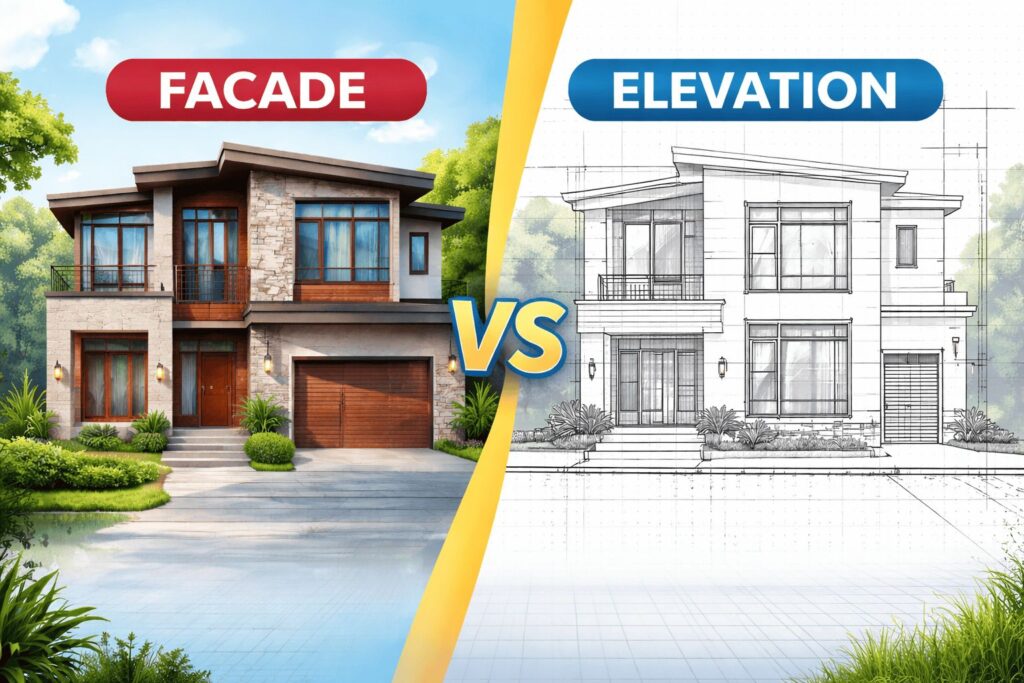
Many people in Nigeria often misunderstand construction terms, especially building design terms like ‘facade’ and ‘elevation.’ This confusion among clients, artisans, and even design enthusiasts has led to poor design decisions and costly mistakes. However, understanding the difference between ‘facade’ and ‘elevation’ is very essential.
In this article, you will have a better insight into why this difference matters in building design and why facade design in Nigeria is important in your building. Let’s discuss.
DEFINITION OF THE TERMS ‘FACADE’ AND ‘ELEVATION.’
What is a facade?
The word “facade” is from the French word “façade,” which means “front” or “face.” In architecture, ‘facade’ means the front or exterior face of a building, i.e., the view people see first, and it often defines the building’s character. An architectural facade on a building balances aesthetics, materials, light, and ventilation.
What is elevation?
‘Elevation’ means to lift up, but in architectural terms, it means a scaled drawing of one side of a building viewed straight on. It can also be defined as a flat, two-dimensional representation of a building that focuses on accurate proportions, dimensions, and structural details. There are different types of elevation, which are front elevation, side elevation, and rear elevation.
The key difference between building facade and elevation.
The difference between building facade and elevation lies in their intentionality and representation. A building facade is a design decision that is intentional, expressive, and strategic. It is carefully designed to control heat, light, privacy, and ventilation. Every opening, material choice, projection, and shading element in the facade is deliberate.
The elevation, however, is a technical drawing that documents what has already been resolved in the design process. Building elevation shows the exact dimensions, alignments, and construction details to builders. In reality, the key difference is that a facade is an architectural language, while an elevation is the builder’s instruction.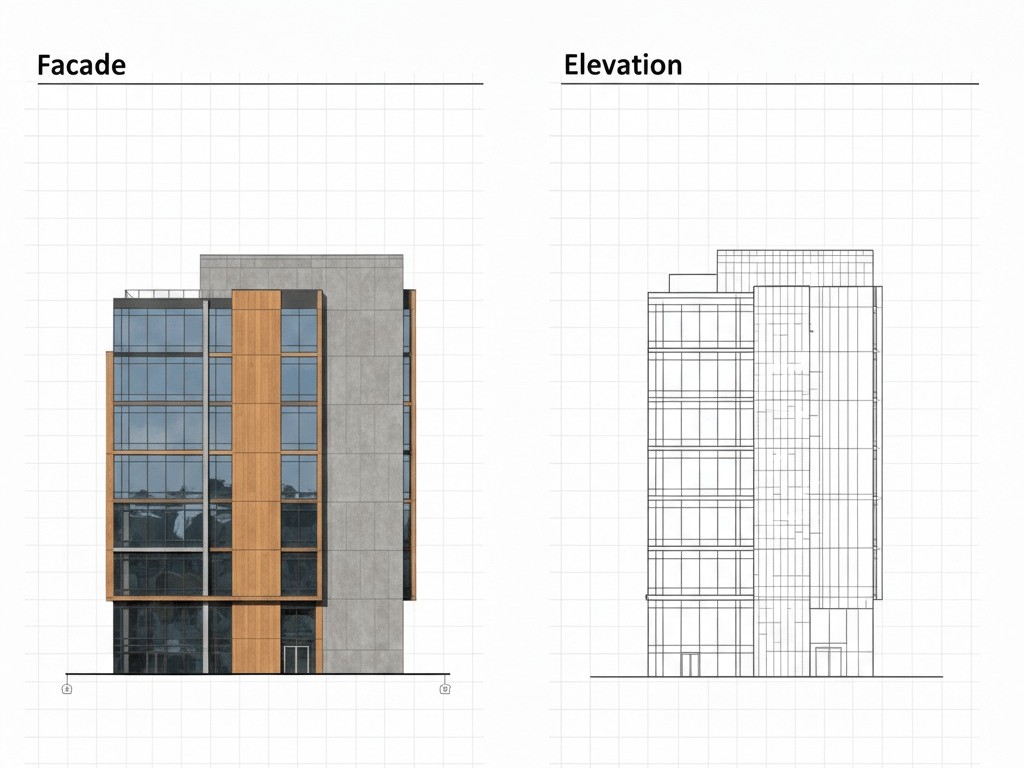
A building facade can change, evolve, or be redesigned without altering the building’s structural logic. In contrast, an elevation shows how to build, not why the building looks the way it does.
THE COMMON MISTAKES NIGERIANS MAKE WHEN USING THESE TERMS: ‘FACADE’ AND ‘ELEVATION.’
Here are the common mistakes and how professionals should correctly use these terms.
1. The use of “Elevation Design” when discussing visual appeal.
When discussing the visual identity, balance, and exterior appearance of a building, use the word facade. But when making reference to technical documentation used for approvals and construction, use the word elevation.
This distinction is the key to understanding the difference between ‘facade’ and ‘elevation.’
Clarifying this improves communication between clients, architects, and builders and leads to better design outcomes within the architectural façade and elevation practice in Nigeria.
2. The act of copying elevations instead of understanding facade intent
In Nigeria, builders often copy elevation drawings from other residential projects. Although architects can replicate elevations, they must design each facade thoughtfully, ensuring it responds to the site, climate, and user needs. The reason for this is that an architectural façade must respond to site orientation, surrounding buildings, climate, and user needs.
Ignoring these results in buildings that look acceptable on paper but perform poorly in reality.
To achieve better outcomes in architectural façade and elevation practice, the focus should shift from copying drawings to understanding design purposes.
3. Assuming the Front Elevation Is the Only Façade
In façade design in Nigeria, a common misunderstanding in building design terms is assuming that only the front elevation is the façade. This frequently results in buildings with a well-treated front and neglected side or rear walls. These untreated façades may face neighboring plots, access roads, or public spaces, yet receive little design attention. Over time, this creates buildings that feel incomplete, poorly ventilated, or visually inconsistent.
In architecture, any visible exterior face can be a façade, depending on its design importance.
Architects and designers often overlook this critical distinction in Nigerian building design, especially on corner plots and commercial buildings.
4. Mistaking a Technical Drawing for a Design Concept
Many people request “the façade” when they are actually asking for a front elevation drawing. An elevation is a representation, not a concept.
Use ‘elevation’ when referring to drawings that show height, proportions, and measurements.
Use ‘façade’ when discussing the exterior design strategy, materials, and expression of the building.
Façade vs. Elevation: Practical Examples on Nigerian Buildings
The difference between facade and elevation becomes very clear when you look beyond drawings and focus on real structures. For example, a typical duplex may have a front elevation drawing showing window positions, balcony outlines, and roof height.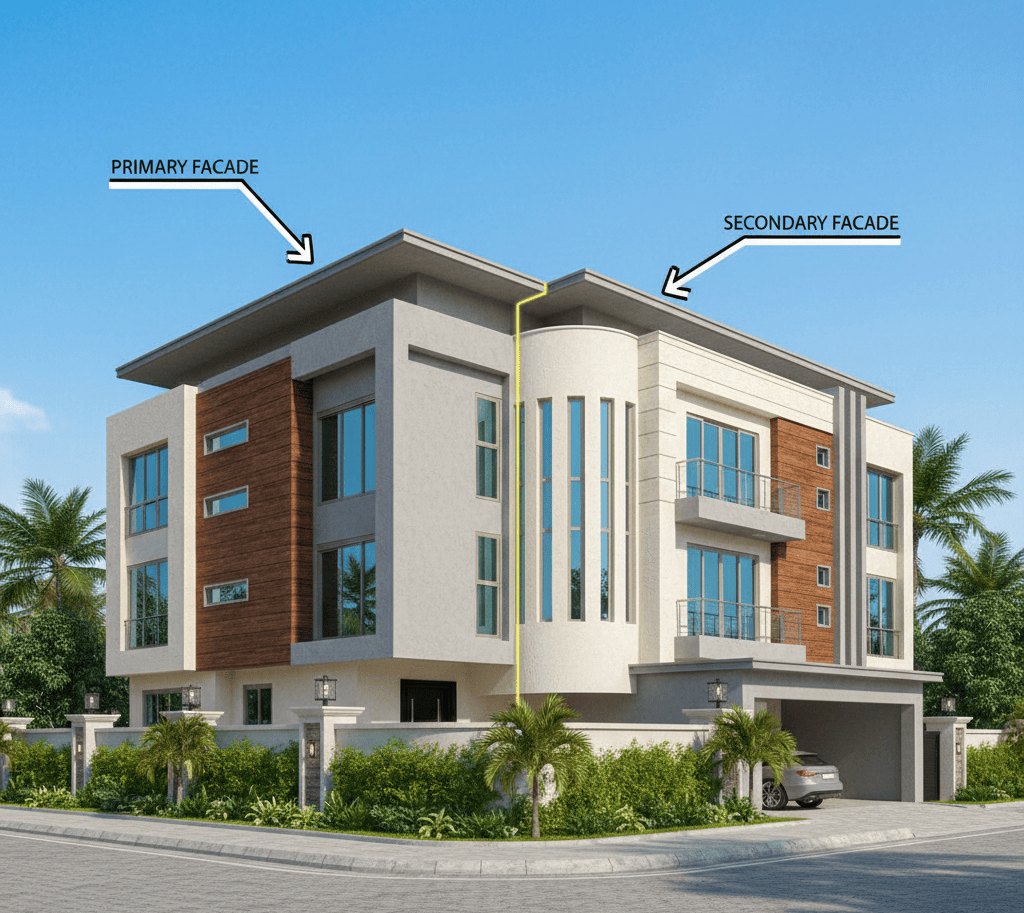
However, the actual architectural facade is defined by how these elements are treated through materials, depth, shading devices, and proportions. On corner plots, more than one side of a building is visible, meaning multiple elevations can function as a facade when intentionally designed to engage the street and surroundings.
During renovations, homeowners often say they want to “change the elevation,” when in reality they are modifying the facade by updating finishes, screens, or external features without altering the technical elevation drawings.
These examples show that in Nigerian building design, an elevation documents how a building is drawn and constructed, while facade design focuses on how the building looks, performs, and communicates its identity. This clearly reinforces the practical distinction between architectural facade and elevation.
CONCLUSION
Understanding the difference between ‘facade’ and ‘elevation’ is more than just knowing building design terms. It is about improving the quality, performance, and clarity of building design. A building facade represents architectural intent. It tells how a structure responds to climate, context, and human experience. But an elevation serves as a technical guide that translates that intent into a buildable form. By using the correct terms, respecting design intent, and understanding the role of architectural façade and elevation, clients, builders, and design professionals can collaborate more effectively and deliver better building outcomes. Also, clarity in architectural language leads to clarity in design and better buildings.
Feel free to contact us today if you need any expert to handle your building for you.


